Tannika’s Writing Vault: Hip-Hop As A Learning Tool Pt 2

This is my new series where I introduce you to some of the past material I’ve written. I have written skits for special events at church and I have also written short stories, some of which I admit are half-done. Did I tell you, I once created my own entertainment magazine in high school! But I won’t be sharing my little paper bootleg magazine. At least for now. Anyway, welcome to Tannika’s Writing Vault and enjoy!
Here is an article I wrote when I was in college studying English: Professional & Technical Writing with a concentration in Journalism. It was subsequently asked to be published on a Hip Hop site but I can’t seem to find the site anymore.

Hip-Hop As A Learning Tool

By Tannika Moore (c) January 4, 2007

Pt 2

Fruchter is a thin white man with short dark hair, glasses and slight facial hair. He mostly dresses in jeans or khaki pants and a tee. He seems to be laid back even when he sits down to talk.

To the students, however, it doesn’t matter that a white man is using Hip Hop to teach them. “I feel like we both can relate to each other,” Cortez McClung, 13, says. “He knows where we coming from and we know where coming from,” he said.

It doesn’t matter to Christopher Taylor, 12, either. He attends Henderson with McClung too and is a regular of Fruchter’s course. “[Hip Hop] is international,” Taylor says.

To answer the critics question of how can he relate to Hip Hop or the African American students he teaches, Fruchter reiterates that he is not teaching Hip Hop, and also refers to his own background.

“There are many classes that teach the history of Hip Hop, and that is important for people to learn. However, I’m not doing that here. I’m not claiming to be a Hip Hop historian. I am using Hip Hop as a vehicle for open communication and engagement with my students.” Fruchter adds, “I have a real passion and love for music. I know Hip Hop and they [the kids] know Hip Hop. If I had to learn Japanese to best reach these kids, I would do that. Luckily, I just have to dig into my record collection.”

Fruchter is also very familiar with the South Side of Chicago. He grew up not far from Henderson Elementary in Hyde Park (another south side community in Chicago), and as a child Fruchter was exposed to a wide variety of individuals and experiences. Hyde Park is known for its variety of races and cultures. The neighborhood made a profound imprint on Fruchter. He says that regardless of what color you are, if you are an aware person, you know what’s going on. And with awareness comes responsibility and purpose.

“Just because I’m white does not mean that I am blind to the poverty, and educational inequality, and other problems that exist on the Southside of Chicago, or throughout the rest of the country. To change anything, you have to go out of your comfort zone. That is another thing that separates this from what is called Hip Hop Academia. I don’t study Hip Hop through books, and magazine articles. I study it by joining community centered Hip Hop organizations, going to concerts, playing music, and interviewing artists. I think it’s important to also show kids that Hip Hop is something that is all around them, and does not just exist on TV.”

Indeed Fruchter loves music and knows Hip Hop. He practically eats, drinks, and sleeps music. Besides teaching a Hip Hop-inspired course, Fruchter also deejays. He’s been deejaying with turntables for three and a half years. He plays all kinds of music from classical to Hip Hop but the most requested music comes from the Billboard Music chart Top 40 Hits.

As a deejay, Fruchter created the mixtape series titled “A poor Craftsman Always Blames His Tools.” Currently, he is a chairperson for the national organization called Hip Hop Congress. The Hip Hop Congress was formed to get people involved in Hip Hop music and culture to be active in their communities. The non-profit program puts events together like can food drives, lectures, free-style rap battles and concerts.

Fruchter is also a writer and the managing editor for SoundSlam.com (a Hip Hop online magazine). He has interviewed over 100 artists including the Beastie Boys, Busta Rhymes, Common, Lupe Fiasco, and Wyclef Jean.

Right now, though, his focus is on inspiring young people to learn through Hip Hop. “I remember when I was their age, and how inspired I would get when listening to music. Music taught me a lot, and helped me to understand the world around me better. I just want to show that to my students.”

He continues to teach the course at Henderson as well as to eighth graders at KIPP (Knowledge Is Power Program) Academy on the West Side of Chicago.

One of Chicago’s top high schools, Morgan Park Academy, has also taken interest in the class. Fruchter hopes to begin teaching “You Can Quote Me On That!” there in 2007. “If I can expose some kids to real creative people (like the Beastie Boys and Mos Def) that inspired me to take ownership of my thoughts, feelings, and aspirations, hopefully some of them will walk away inspired as well,” Fruchter says.

Fruchter pauses to take his time to reflect on what he wants students to walk away with. “A sense of control for themselves, their future and lives,” he says. “I want them to walk away with a better understanding of psychology and sociology and how it affects them. And I want them to walk away with better reading and writing skills.”

With that in mind, Fruchter saw a need for children to learn psychology and sociology when he was teaching full time. Fruchter believes that psychology has helped him to see things in his own life differently. He feels like this course can help address some of the issues like self-efficacy, conflict-resolution, self-concept (these are a few topics discussed and taught in the course) in their lives.

Keondra Booker, 9, says she learned more about social skills from the course. More profoundly, she calls out two of the psychology/sociology terms she learned in the course. “I remember self-concept and self-efficacy.”

Fruchter, who graduated from Indiana University with a Bachelor’s degree in both psychology and sociology, wants the students to be active listeners and critical thinkers. “The kids respond well to Hip Hop.” Plus, Fruchter believes that if Hip Hop artists are willing to put their music out, we are either going to listen or not, but it would be better to think or analyze what we hear.

“You won’t get the real meaning of the song, if you just listen to the beat,” Taylor says. Taking this class has helped him to pay attention to the lyrics, something he didn’t do before. McClung believes the lyrics are the most important part of the song. As for Booker, she believes you get a sense of emotion when you pay attention to the lyrics and not just the beat.

With a good response from the students, Fruchter plans to get the course in more schools and the lessons much tighter. He has researched the songs, principles and theories that he teaches and applies to the lessons to make sure they are as accurate as possible.

Fruchter has been meeting with Chicago Public School officials, has performed a trial run at Henderson to get it taught during the day, is seeking a vendor’s number, and wants to put together workbooks and materials to support the course.

Richard K. Richardson, principal of Henderson, observed the course trial run. He noted that the students were interested and involved in the lesson that included reading, writing and critical thinking. “I think it [the Hip Hop based course] could be used to develop reading and writing concepts, but it needs to be aligned with the reading and writing objectives.”

Fruchter agrees, and is currently explicitly aligning all of his lessons to the Illinois State Learning Standards, many of which are already touched on in his class. He also wants to add an ISAT prep component, to add to the program’s appeal. Eventually, Fruchter wants to train others to use Hip Hop to communicate sociology and psychology to young students, especially if the children are listening. “My plans [for this course] are to keep doing it, refine it and expand it.”

____________________________________________________________

If you haven’t read Pt 1 of this article, click here: Tannika’s Writing Vault: Hip-Hop As A Learning Tool Pt 1

Daily Habits That Improve My Quality of Life

What daily habit do you do that improves your quality of life?

I will get straight to it. My daily habits that improve my quality of life are:

  • Making my bed every morning. It is a small discipline that makes a big impact. “If you make your bed every morning, you will have accomplished the first task of the day. It will give you a small sense of pride and it will encourage you to do another task and another and another”–William McRaven
  • Pray or acknowledge God. Let me be honest. I am not always stopping to pray in the morning but better believe by the end of the day, I have sat down with God in my heart to say thank you, share my heart, pray for my self or someone else. And I am learning to listen more because prayer with God is a dialogue and not a bringing of a list of wants. Yes, come to Him with what you need and even discuss your wants. To clarify, bring to Him every content of your heart (everything including fears, disappointments, goals, etc.) but make sure you learn to listen to what is in His because He knows what is best for us. His purposes always come to pass and His plans always succeed. Moreover, prayer is about getting to know God and inviting Him into every area of your life.
  • Read the Word of God. I don’t care if it is the YouVersion scripture of the day or a random chapter or a chapter or three of a God-led lesson I am currently studying, I read His Word. Have I missed a day or two or three? Honestly, yes, but it makes so much of a difference when I sit down to read and hear His Word.
  • Another daily habit of mine is making a list of things I am grateful for. This puts things in perspective and lifts my spirit as I list all of the things I am grateful for, no matter how small they may seem.
  • This isn’t daily but I go over my goals list. I have always been goal oriented and like to reflect on and assess my goals and where I am in accomplishing them.
  • I also journal or work in my planner. This helps me to sort out my thoughts, plan and stay organized.
  • Lastly, I make a daily habit of choosing to get up and choose peace and to better myself. Thank God for His grace to be able to do so.
Let’s Take This One Day At A Time Planner Available at Amazon.

Last Summer Project

I have been under the weather this week but Friday, I pressed through to complete a project that I have been wanting to do for awhile. I have been wanting to make some changes to my room and definitely wanted to do it just in time for the school year. So, after seeing my nephew to the bus stop for his first year of high school and cleaning the house, I started my final summer project.

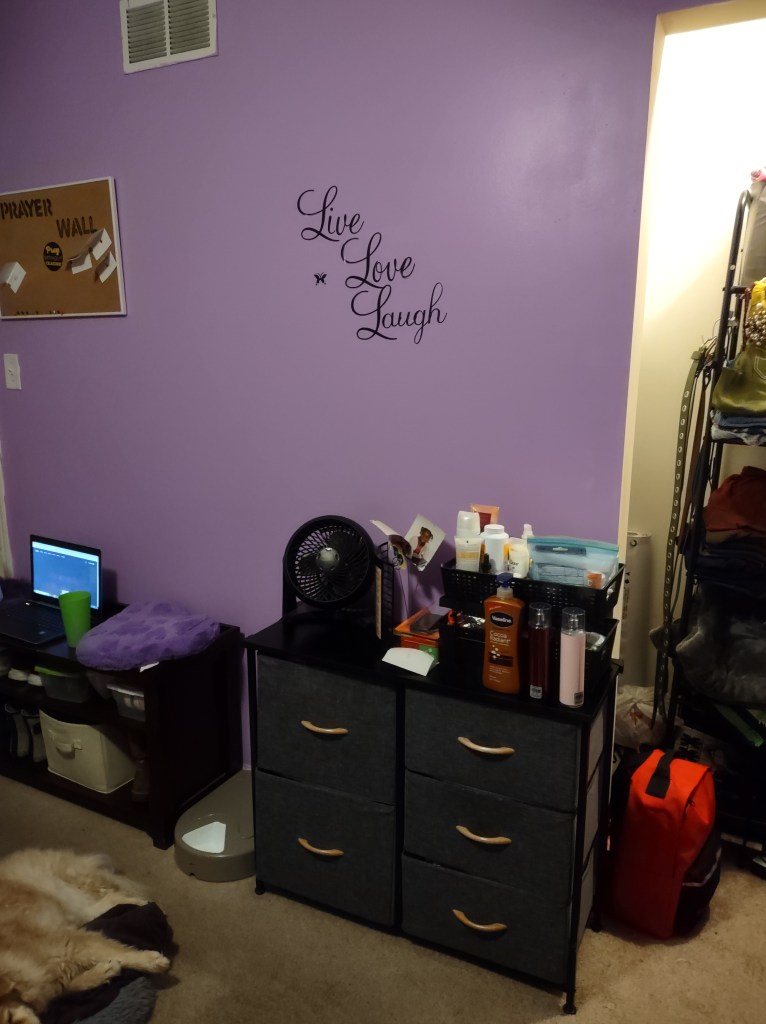
I painted my room and reorganized it to give it an ambience of peacefulness, warmth, femininity and a bit of chicness.

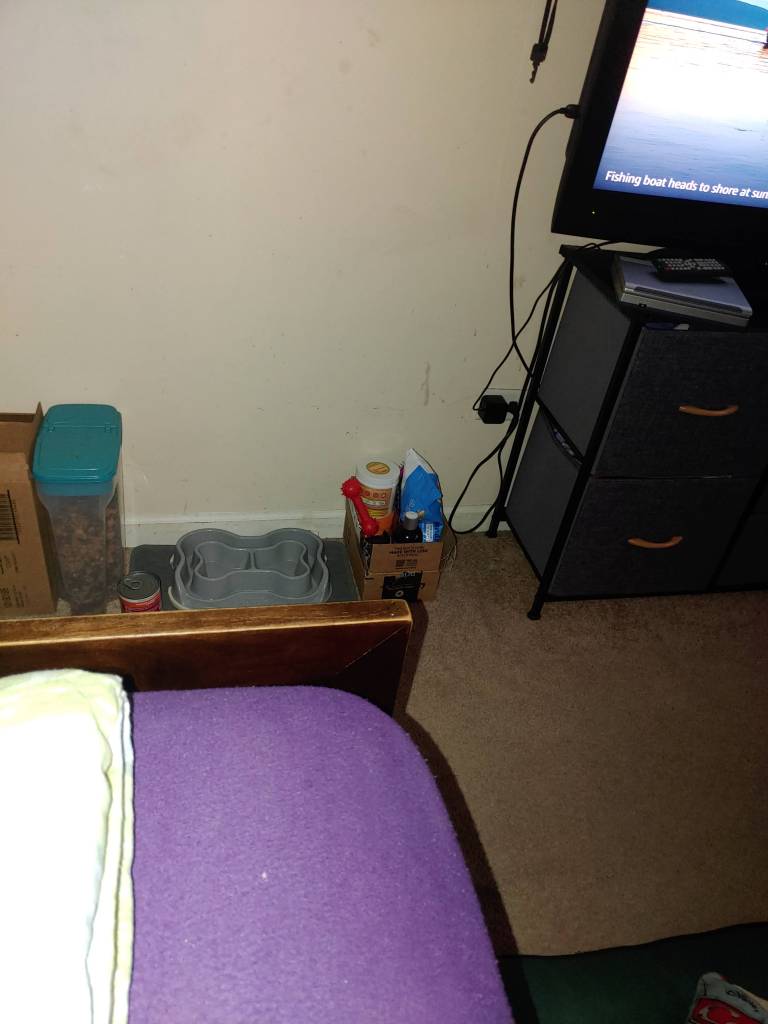
These are my before pictures:

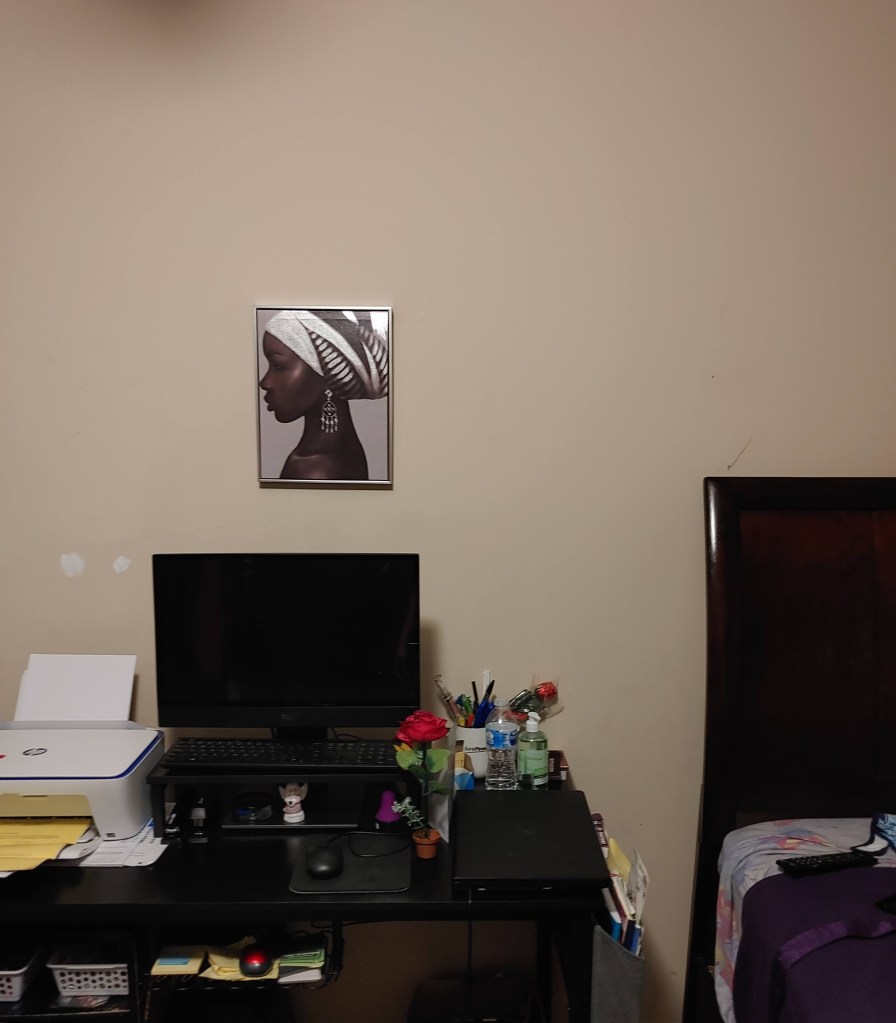
As always it is fun doing these painting and redecorating projects but they are tiring and I make a lot of boo-boos. But overall, I am pleased with the end result. Here is how it turned out:

What brings Me Peace?

What brings you peace?

First, I would like to say with all sincerity that Jesus brings me peace. His peace surpasses all understanding. He is my peace in the midst of the storms. His peace cannot equate to any other peace.

There are things though that also help me to cherish and maintain my peace, rest, and even my solitude, memories and moments.

Having a day off doing things I love: watching movies, mysteries, or old shows or even listening to music on my headphones helps me to rest and cherish my peace.

Also having a day off to catch up on goals, tasks, projects, and more helps me to rest well.

Taking a walk especially through a flowering, grassy field or on a beautiful walking trail adds to my peace. It feels so serene.

Spending time reflecting and journaling helps me to maintain my peace. Encouraging others and spending quality time with my family adds to my joy and peace. 

Bucket List: A Concert w/My Fave Group

This Friday, I was elated to check something off of my goal/bucket list. I attended a concert of my favorite group, Jodeci, and with my Jodeci boots in tow.

It was the Summer Block Party Tour with Jodeci and another fave group of mine, SWV.

I attended with my best friend and we had a ball!!!!!

I was so excited that Jodeci, a popular R&B group, R&B legends of the New Jack Swing era to the Hip Hop Soul era, was coming to Chicago. And that they still are going strong through it all. Same for SWV, one of the many girl groups of the 90s (a time where many girl groups were able to thrive and reign at the same time), R&B legends in their own right also.

Something my sis and I noticed was we didn’t realize just how strong the voices of the ladies in SWV are live. Sisters With Voices can sang!!!!

And K-Ci’s voice is still strong too. He has always been one of my favorite singers. Through it all, Jodeci’s ups and downs, I was proud to hear the whole (all four were present, ladies😌) group singing sanging and still sounding good together!!!!

R&B kings and queens: they put on awesome shows!!!!!

There was so much nostalgia listening to them as well as the other hits the DJ played before the concert and during the intermission.

Tannika’s Writing Vault: Hip-Hop As A Learning Tool Pt 1
This is my new series where I introduce you to some of the past material I’ve written. I have written skits for special events at church and I have also written short stories, some of which I admit are half-done. Did I tell you, I once created my own entertainment magazine in high school! But I won’t be sharing my little paper bootleg magazine. At least for now. Anyway, welcome to Tannika’s Writing Vault and enjoy!

Here is an article I wrote when I was in college studying English: Professional & Technical Writing with a concentration in Journalism. It was subsequently asked to be published on a Hip Hop site but I can’t seem to find the site anymore.

Hip-Hop As A Learning Tool

By Tannika Moore (c) January 4, 2007

Today is Wednesday. It is a little past three in the afternoon and a young group of students are talking and laughing with each other while awaiting today’s instruction.

Like any teacher, Mr. Alexander Fruchter gathers his teaching materials. But instead of a teacher’s edition and a grade book, he pulls a couple of CDs out of his bag and plugs in the portable CD player. He loads in one of the CDs and presses play.

After the chorus, Evidence (member of Hip Hop group Dilated Peoples) begins spitting 16 bars of rap lyrics on “You Can’t Hide, You Can’t Run”.

“On to me, I’m on to you, it’s no mystery

Better think fast, the future just was history

This is where the plot thickens, regardless of wealth

Cause the worst person to run from is yourself…”

As today’s worksheet, Fruchter gives each student a print out of the song’s lyrics and a Hip Hop quote of the day written response sheet.

If Hip Hop was a person, it would be the most popular football player (maybe Basketball player) in high school, sought after by ten college recruiters. Hip Hop isn’t a person, but it is popular and it continues to grow.

It has travelled from the 1973 block party in New York to the university lecture halls and has finally stopped off at a class of third to eighth graders on the South side of Chicago.

While a host of universities like Stanford add Hip Hop courses to their registration books, Fruchter has opted for a more familiar classroom setting.

“My goal is to teach elementary and high school students in the city. These kids are starting out on their academic career and I feel that these kids can benefit more [from this course],” Fruchter says.

But Fruchter makes it clear that this is not a course simply on Hip Hop history and culture. “I don’t consider this as Hip Hop academia and I’m not saying I am a Hip Hop historian,” Fruchter says.

Instead Fruchter says that this is a course that uses Hip Hop to communicate to the children and teach them psychology and sociology. He also uses this course to enforce reading and writing.

“I call the course ‘You Can Quote Me On That’. It is primarily a psychology and life skills class. But it also teaches poetry techniques, critical thinking skills as well as reading and writing.

For 24-year old Fruchter, teaching grammar school students is nothing new. He went through the Teach for America program where they recruit candidates who will commit to teaching for two years.

After being certified, Fruchter started teaching full time, in 2004, first as a summer school teacher in Los Angeles and then as a second grade teacher at Charles R. Henderson on Chicago’s South side Englewood area.

Fruchter made the switch to fifth grade in 2005, at Henderson. So, to most of the 15-20 students that show up to his “You Can Quote Me On That!” course, Fruchter is a familiar face.

Stay tuned for part 2…